
Meet new member Ruth Greenwood
Ruth’s etchings explore everyday objects and combine delicate lines with Baroque and Arts and Crafts influences. She talks about how a precious inherited ink pen led her on a journey to etching, and shares some of the inspirations behind her work.

How did you get into printmaking?
I started out making little botanical drawings with an old ink pen I got from my grandad. I inherited his art box – handmade from wood, full of tiny drawers packed with pencils, pens, oil paints, and even a ceramic roller. I was totally fascinated, and it’s still one of my favourite things.
I made some ink pen illustrations of iris and ivy and I wanted to develop them, so I joined the evening etching class with master etcher Nick Richards at Thames-side Print Studio.

How did you feel when you first tried etching? Did you know immediately that it was something you wanted to keep doing?
When I started to learn etching, I was very much a complete novice. I understood relief printing and screenprinting with stencils, but I couldn’t picture how the ink was transferred from metal plate to paper. So when I pulled my first intaglio print, I was astonished. The areas that held the ink were three-dimensional because we had etched aluminium and the incised lines were quite wide. When I tried a little ivy design on a zinc plate, I got the thrill of the reveal. It was so uplifting, I felt delighted, it was a little bit like magic. Then there was the curious effect of the image being not quite what I was expecting. It’s difficult to explain, sometimes there would be a random shape that seemed to come from the subconscious. But it all worked.

Why etching?
I love how hands-on etching is. It’s not just about keeping up old traditions; it’s also about finding new things along the way. Sometimes a random mark or a spot where the acid bites a bit deeper ends up being what really makes the print stand out. Etching keeps me on my toes and reminds me to go with the flow, accept little surprises, and just trust how things turn out.
Where do you get your inspiration from?
Usually it’s an everyday object that leads me on a journey – sketching, studying, exploring its shape and form, developing the ideas. I’ve made a number of prints about apples, which originally came about because I visited an open studio of a relief printmaker in East Sussex before lockdown, and he had an apple tree. I took an apple and made several observational drawings, watched them shrivel and decay, and then made a painting using acrylic paints. Months later when we were allowed back in the studio, I used the sketches to create a larger etching called “Apples”. I am continuing to use this theme and have subsequently made few different larger compositions.

Developing these still life prints, I drew inspiration from the Baroque style by introducing dark, shadowy backgrounds and strong directional lighting. This approach helps illuminate the subject and allowed the shapes to emerge from the shadows, giving each piece a sense of depth and presence.

What is your printmaking process like?
Usually, I start with a rough sketch on a piece of steel with a hard ground on it, to get my ideas going. If the etching turns out how I like, I’ll print a small batch; then, I’ll add some colour to a print to see where the image can go next.
I start with a steel plate, coat it with a hard ground, and then work out my composition by drawing into the ground with a dip pen. Where the nib scratches away the ground, the acid will bite into the plate, creating lines that will later hold ink.
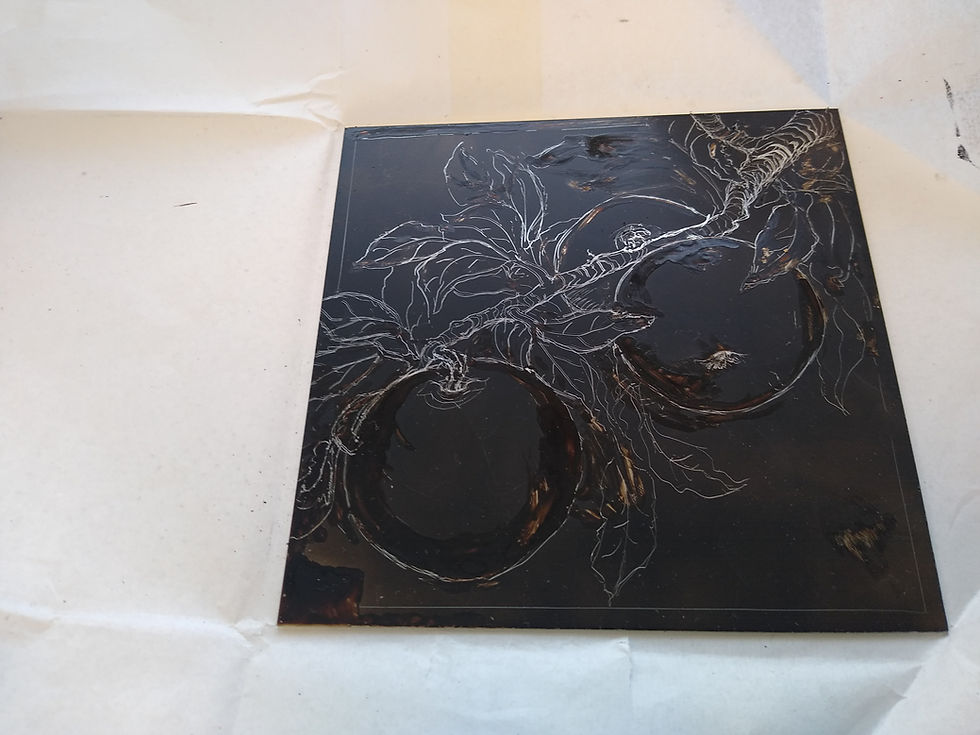
When I want colour, I aquatint the steel. I want the depth of a shadow, but also I’m conscious of the way an object will cast its colour and light the back onto another object. It’s tricky. I etch the tones in a few stages. Stopping out the highlights first gives me where the light is coming from, then I dip the plate for 30 seconds, or maybe a minute or two, rinse, dry and stop out the next area, dip, rinse and repeat. It can’t be rushed, but has an immediacy that I can’t stop and leave it until later, I have to complete this part of the process once I’ve started it. The final dip might be for seven or eight minutes, in an attempt to get a true black. The texture of the steel will hold a light tone and I burnish this to create the almost white areas.
After inking and wiping the plate by hand, I run it through a press with dampened paper. What emerges is always a nice surprise – and that’s the beauty of it. Each impression carries subtle variations and textures unique to printmaking.

How do you go about choosing colours?
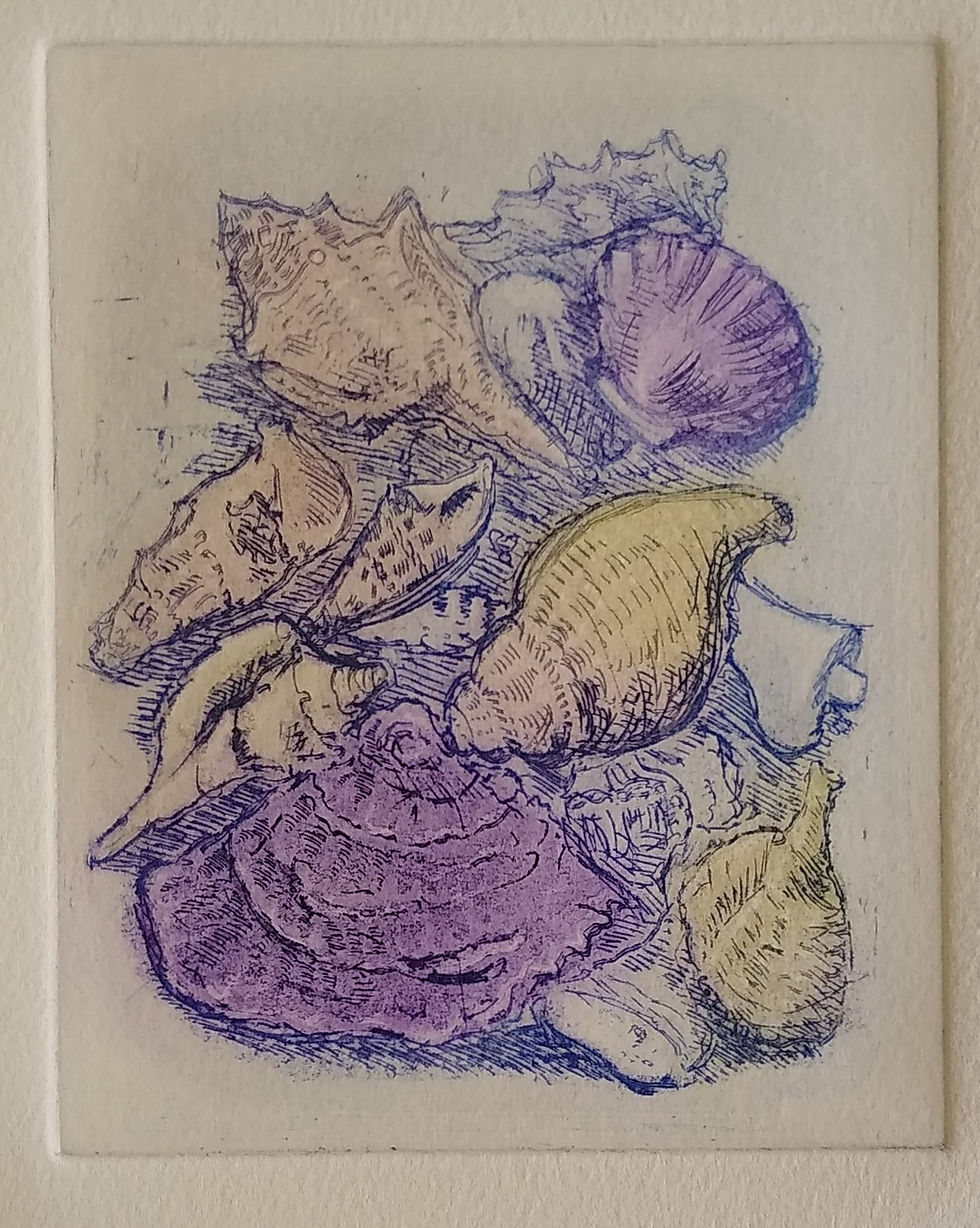
I like to use a limited palette, four colours, three that I mix for each fruit. So at the moment I am using azure blue, apricot yellow and Solferino violet, which is a super-juicy plum colour. These colours are restricted to the objects and I use burnt umber with a little sepia or black mixed in for the backgrounds and lines. I put the background colour down first, then work in the colours, so there is a bit of mixing on the plate as well as pre-mixing the palette. For example, the apricot in “Apple Pear Apricot Plum” is apricot yellow with a tiny smear of Solferino violet to give it that blush, but also, it’s placed next to the plum, so it’s a little bit of the plum colour reflecting onto the apricot. I’m also using the inherent qualities of the inks which have different viscosities to achieve this.
I well and truly fell down the rabbit hole when I started reading about viscosity printing. A technique I want to explore further.
What are you working on at the moment?
As well as revisiting a couple of old plates that are not quite where I want them, I’m continuing to create larger still life prints. After “Fruit Bowl”, there is “Fruit Bowl with Grapes 2.0”, which I’m showing at Woolwich Contemporary Print Fair with Thames-side Studios. Another I’ve titled “When Life Gives You Lemons, Print”. For this one I add colour using chine collé, Japanese paper I stained yellow myself, because I couldn’t find enough of the same yellow paper from suppliers, but I could get pale buff paper which I stained with ink. I’m working on two more and one even larger plate, all at different stages of the process, and I’m really excited about seeing them printed in their various states.
Ruth Greenwood's prints are available from the Greenwich Printmakers gallery and there is selection of her work on our online shop. For more information, see her artist's page on our shop or her website.


Comments