
Behind the print: "A Soft Embrace"
Our featured artist Lucy Ward's atmospheric prints take inspiration from real-world landscapes, imagined stories and cinematic lighting. Lucy talks about the inspiration behind their etching, “A Soft Embrace” and how taking part in a residency kick-started new ways of working.
Why did you decide to make this print?
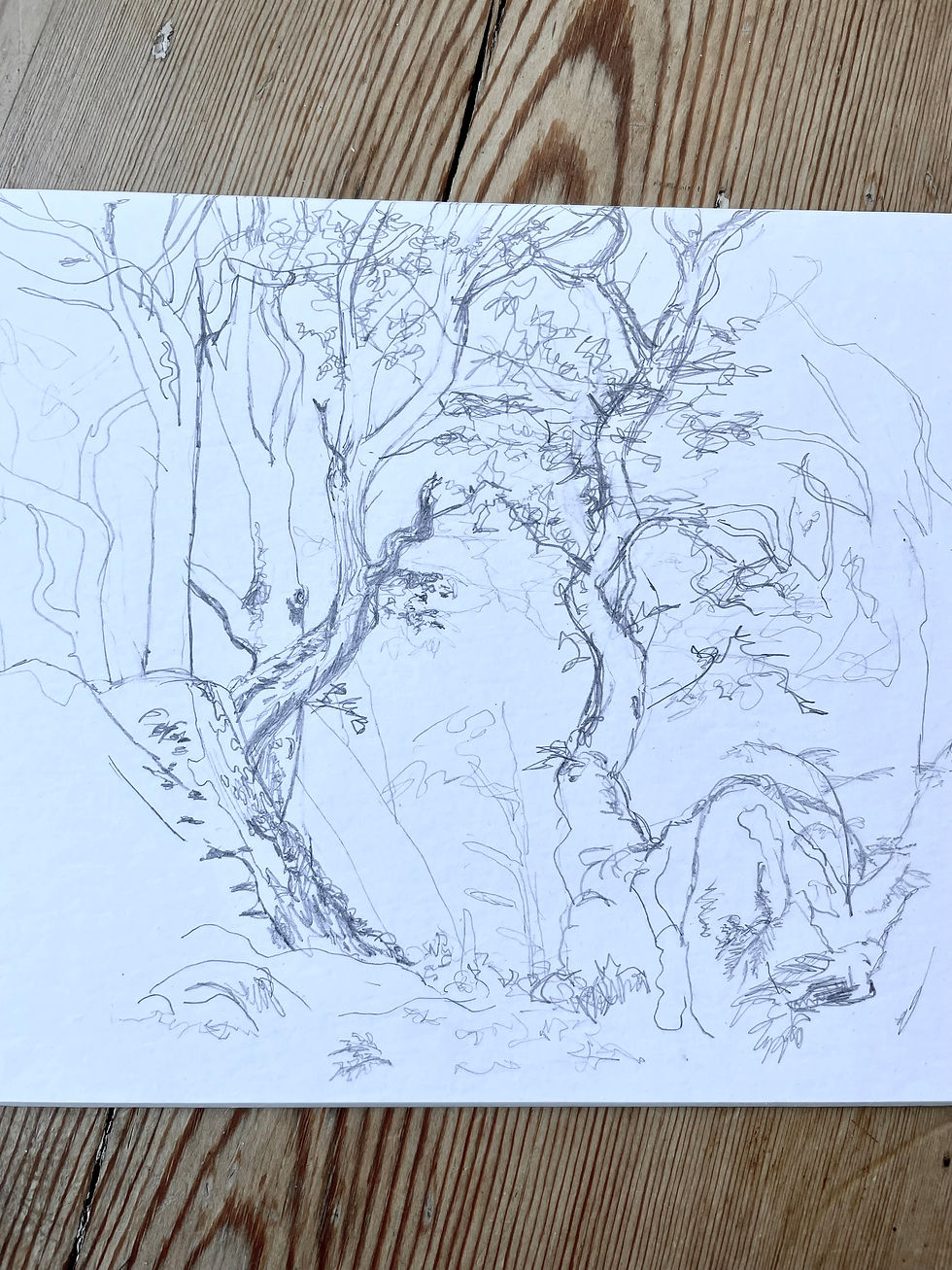
This is one of the ideas that came out of my residency in Mawddach, Wales, when I spent a lot of time in the woods drawing these amazing twisty trees and stratified rocks. This area is home to the Celtic rainforest, full of moss, lichen and ancient oaks. I have a trove of sketches and photos from that time, but the experience itself of just sitting in the woods by myself for hours at a time, allowing myself to become part of the landscape and watching nature flow around me, was really valuable. It’s a place that feels both full of vibrant life and somehow outside of time.


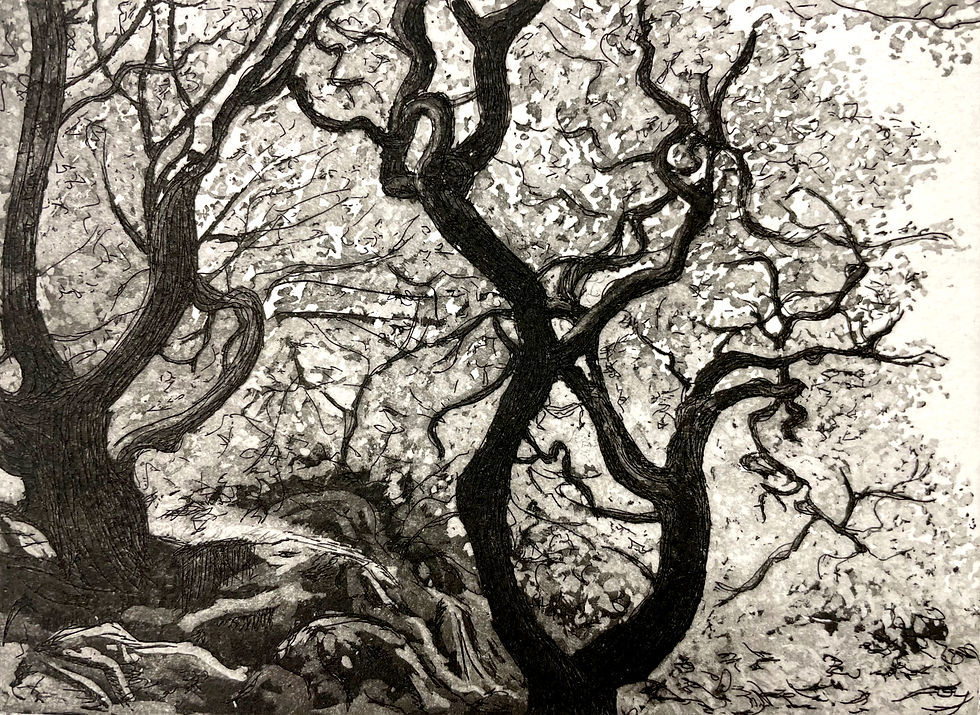
The scene in “A Soft Embrace” is at the edge of the wood where a path over the hills joins the trees. The path is just out of shot on the right of the print. I left it out of view because I wanted the focus to be on the wood, with the clear sky area on the right suggesting the landscape opening up, another option. The idea was to give a feeling of a crossroads - you could walk into the woods or away from them. But the perspective shows the decision has already been made, you’re already starting to turn towards the trees.

With “A Soft Embrace”, I wanted to capture the sun-dappled light, the soft rustling of the leaves, the desire to sink into the lush moss and be at peace with the wood, as I was when I was on the residency. There’s an imagined story, a tension - who will appear around the corner, from the hill path? The woods are ancient. Perhaps in years past someone waited for their lover here once, watching for their arrival. Perhaps they became a folk tale. Perhaps they are still there, together under the moss. Did I mention I like a spooky story?
On a more metaphorical level, this print is about friendship and family, chosen and blood, and the support, care and affection I am lucky enough to receive from mine. A network of deep roots and interwoven branches.
How did you make “A Soft Embrace”?
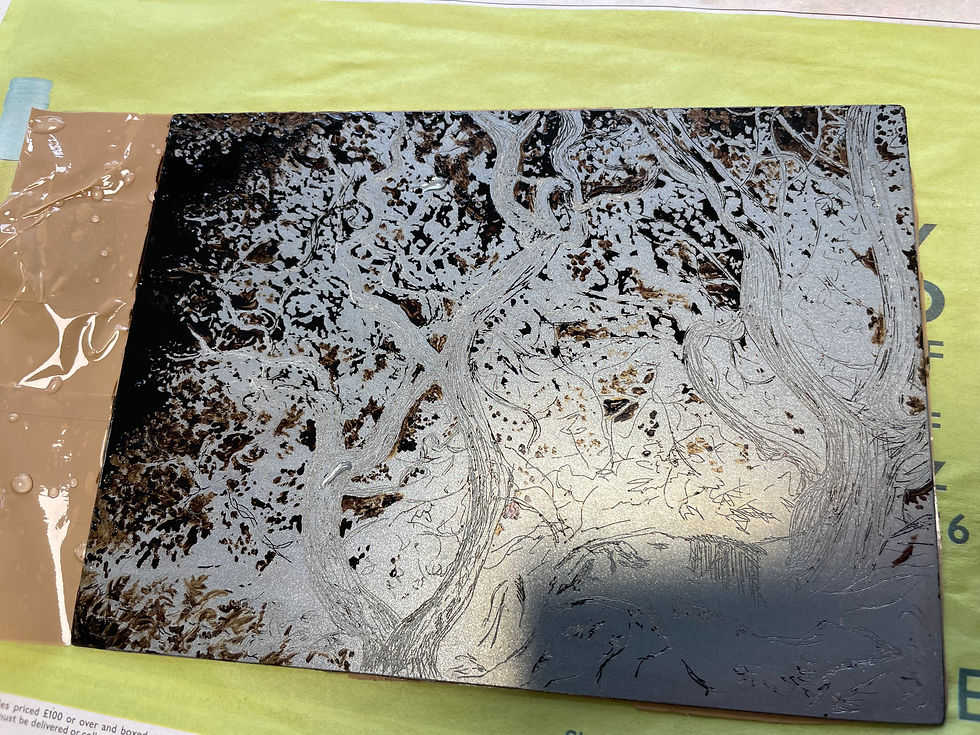
This was a new way of working which developed out of the sketches I did during the residency. Previously, I had mostly either been working in pure aquatint tones for my etchings or I had etched a very careful, precise line drawing in hard ground and then added aquatint tones within those lines. But I loved the energy of my residency pencil sketches and I wanted to bring that into my prints, so I challenged myself do a very quick sketch on the plate covered in hard ground, with the focus on the feel of the tree and rock shapes rather than accuracy.

I etched that in the acid, took a proof of the line drawing, and then worked in aquatint and sugar lift to add dimension to the plate, not necessarily following the lines of the drawing. Each tone has to be “stopped out” with varnish after it’s been bitten by the acid before it goes in for the next bite, working light to dark, so it’s a lot of thinking in reverse and back to front. It’s quite difficult to see what you’re doing by the time you’re halfway through because of all the varnish layers, so you have to just work on instinct and commit to the image you think is under all of that, and hope when you print it it’s worked as you thought.

I’m so pleased with how it turned out. I think it has a lot more energy and movement because you can still see the sketchiness of the hard ground etching underneath, and it has a really nice embossed texture in person (which unfortunately doesn’t show in photos very well).


I also changed both my usual paper and my usual ink - it’s a mixture, actually - for this print to get just the right colour and mood, so it was quite a lot of experimentation and a long road, but I think it’s really been worth it. This new process is something I can take into my future work too.

Are all of your landscapes real places?
Yes and no. All of my prints are a combination of observation and imagination, and they might look quite similar to the original sketches or photos or end up looking quite different as I change things to suit the mood I want to create. There are usually several layered meanings or emotions in each print.
If I say a print was inspired by a particular real-life event, it takes away the chance for someone to relate to it in their own way, and I would rather it resonate with them, so I generally don’t expand on any personal meanings too much unless I’m specifically asked.


I like to make prints that I feel have a tension, like it’s a few seconds before someone’s going to walk into the frame in a film, or it’s some time after an event has happened on that spot. I want people to be able to imagine stories around my prints.
If people want to see my work purely as landscapes, that’s ok too. A customer once said that they look at my print on their wall every day before they go out and it makes them feel happy because it reminds them of somewhere they used to live, and that’s the best review I’ve ever had.

What artists have influenced your work?
My degree was partly in film, and I think you can see that through my use of strong highlights and shadows. Some of my influences include David Lynch, film noir, nature books/documentaries, Félix Vallotton, Edward Hopper and Tirzah Garwood. I’m also interested in folklore and history, so I try to see landscapes in that context - as a snapshot in a wider timeline, and that our current version isn’t static.

What are you working on at the moment?
I have so much material to work from that came out of the Mawddach residency, so I’m really excited to make a lot more prints inspired by that. I have a few ideas on the go for etchings, maybe working slightly bigger. And I would like to do some more monotypes, I really like the translucent effects and the marks you can get by rolling and scraping the ink. I would also like to make some more prints of local landscapes using my new working process for etching, maybe by taking a plate with a hard ground coating on out with me and drawing directly on the plate.
Lucy Ward is the featured artist at Greenwich Printmakers until February 15 and their prints are available at the gallery and in our online shop all year round. For more information, visit Lucy’s artist’s page, website or @lucywardprints on Instagram.


Comments