
Featured artist: Catherine Gerbrands
Catherine Gerbrands creates atmospheric, folk horror worlds you can get lost in. Inspired by artists including Richard Dadd, Gerald Scarfe, Ian Miller and Leonora Carrington, Catherine (she/they) makes intensely detailed mezzotint and drypoint prints that have wonderful texture and depth. A talented singer and multi-instrumentalist, their music and art feeds off one another and they have performed in galleries and designed album covers. Catherine is our featured artist in the gallery until January 25.

How did you get into printmaking?
I started drawing at the age of three or four. As an autistic child, this, of course, became an obsession. I began with pencil and pastel and then started working in oils around the age of eight (I skipped acrylics and watercolour til much later!) thanks to a local artist who let me loose in his studio. Oil paint and pastel became my favourite media. When I began using ink, I enjoyed the delicate lines I could achieve, but always felt they lacked depth and texture. I started washing over them with water and other inks. Later (as late as 2019), I did a printmaking course and had the revelation that I could get the desired effect drawing by directly onto unpolished copper.


What printmaking techniques do you like to use?
Drypoint is my go-to printmaking technique. My other favourite is mezzotint, in which the whole plate is ‘rocked’ (pressing a serrated-edged tool back and forth across the surface until it is all rough and able to hold ink). If you were to ink and print the plate at this point, the whole thing would print as a solid colour. To create the image, you burnish away areas, which will print in varying tones or white, if completely smoothed. This has a similar effect to a high-contrast pastel or charcoal drawing and has dramatic and satisfying depth.

You’re interested in folklore and are influenced by surrealist fantasy illustration. You also employ pareidolia – the human tendency to see patterns in the natural world. Tell me more about that.
My technique is very detailed. A small plate can take me weeks to complete, so my influences are artists whose work you can get lost in. From Richard Dadd’s fairy paintings to Ian Miller’s insane landscapes and the under-appreciated women surrealists such as Leonora Carrington, I love anything that transports me to another world. There’s always a dash of the sinister as well, so people have also cited Bosch, Goya and Blake when looking at my work and I describe my art as ‘folk horror’.


My first big inspiration, as a child, was Gerald Scarfe after I – perhaps inappropriately – was allowed to watch The Wall, with its wonderful animation so brimming with grotesque transformation.
My early work was full of swirling creatures and human forms and later I moved more into the natural world, to which folklore is intrinsically connected. Fairytale imagery – dark forests and Grimm’s cautionary tales – become inevitable subject matter.

“Mawddach Maiden”, a drypoint completed during a residency I went to in Wales with fellow Greenwich Printmaker Lucy Ward, was inspired by legends such as selkies and sirens. I imagined the Mawddach estuary where we stayed having its own creature, emerging from the bladderwrack, who lures sailors onto the sandbars.

I was married in a pagan ceremony in my favourite forest – Epping, just north of London – and I live very near the Bostall Wood to Abbey Wood corridor, so I have plenty of places to get lost in. The dark textures of mezzotint also suit the crepuscular light in a shadowy woodland.

You’re also a professional musician. How does music overlap with your artwork?
My art and music feed off each other. Their subject matter is the same. I have worked with various bands, playing saw and singing. “The Witching Tale” print was done as a limited edition vinyl version of the band’s first album, a psychedelic folk project from Mediaeval Baebes’ Katharine Blake.

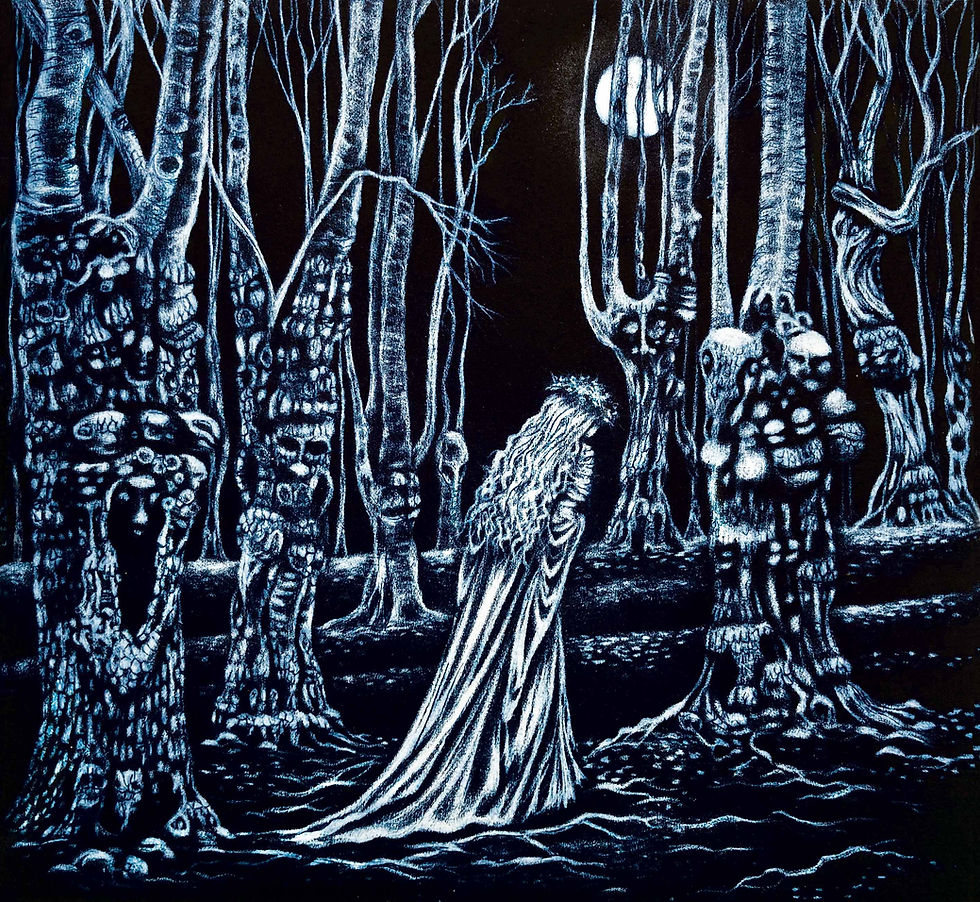
The mezzotint “The Offering” (a self-portrait of me on my wedding day in Epping Forest) was done for the cover of my own band’s first album. Seven-Headed Raven consists of me, my husband on cello and Liene Rudziša, who plays the Latvian traditional instrument the kokle. Unsurprisingly, we sing some traditional songs and write our own, mostly about strange things happening deep in the woods! Our song “The Fairy Painter's Master Stroke” was commissioned for an album compilation by Jowe Head (also an artist and musician that I perform with) that consisted of songs about artists. Of course, we choose Richard Dadd, whose tragic story – he killed his own father and then ended up in an asylum – we imagined through the lens of his most famous painting.

Catherine Gerbrands is our featured artist in the gallery until January 25 and their wonderful prints are available there and in our online shop all year round. For more information, visit their artist's page and their website, or follow them on Instagram at @catherinegerbrands.
Their band Seven-Headed Raven performs regularly and you can listen to their album on Bandcamp.


Comments