
J. Yuen Ling Chiu: “Understand the medium deeply, so when you want to break rules, you can do it beautifully”
Our featured artist Ling talks about ‘thinking through printing’, how travelling with minimal art supplies can open up creative freedom, and how a recent commission for a histopathology department led to experimental prints that react to touch and UV light.

You use a lot of different techniques, changing between them and sometimes combining them to make your work. How do you go about deciding which technique will be the best for each idea?
I think I would describe my making practice as ‘chaotic brute force’. With my pigeons, for example, I’ve worked with screenprint, etching, lino, woodblock, and lithography in my search for most ‘pigeon-y’ pigeon. Really intimate, delicate lines and tones? I’ll turn to copperplate etching. Expressive, impulsive, reckless splatter? I’ll start with lithography, but that doesn’t mean I’m stuck with it – each process informs the other.
It can also depend on what I have to hand – I’m trying to buy less and work with found materials, discards, and what I already have. At the studios where I’m based, people are always coming and going, and leaving things behind. I recently inherited a mixed pile of used/imperfect/offcut copper and I cannot wait to get stuck into that.

Sometimes I really luck out. Last year, I worked with a fantastic team at CUH Arts on a commission for Cambridge University Hospital, creating a large body of work for the new Histopathology department. Instead of choosing a single technique or style from the outset, my approach was to learn everything I could about the site, the processes used in the labs, the people working there, and the surrounding countryside.
I gave myself time to learn, time to experiment, and time to produce, and the team helped me distill the chaos into a series of photopolymer prints, screenprints, collages, and works on brass, that really show the diversity of the people, process and place of the new lab. I’m really proud of that work, and excited to show editions from the commission as part of my FA show.
More information can be found about the commission here:

You approach printmaking as a way of thinking and figuring out ideas as well as making a finished artwork. Can you tell me a bit about this?
I guess it’s habit? I’ve been printmaking regularly for more than 25 years (!), so it has become an instinctive and natural starting point for any visual adventure. I’ll pick up a drypoint plate or a bit of lino, the same way someone else might open a sketchbook.
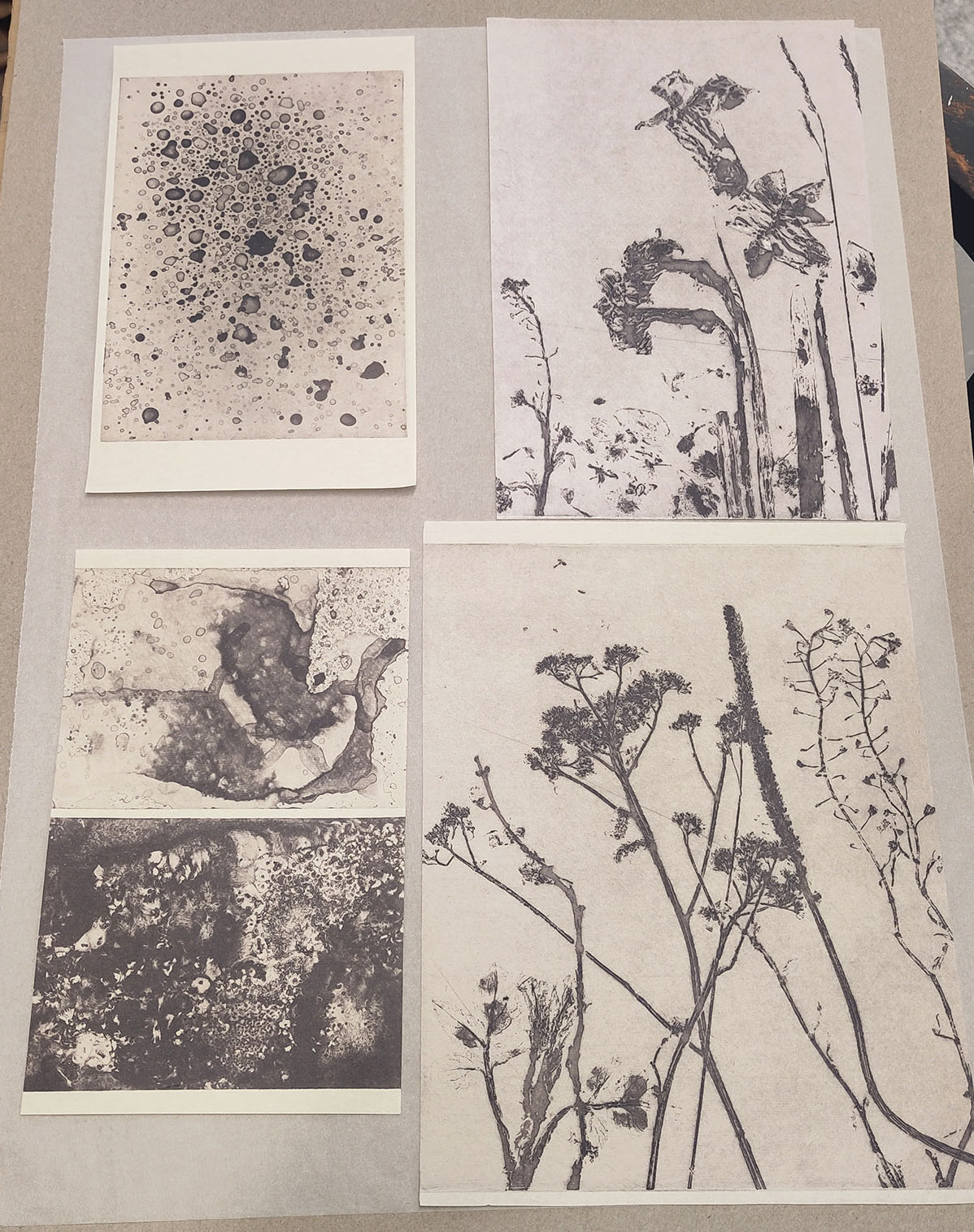
For example, I’ve been observing a houseplant in my flat for the last two years. It lives in the kitchen/office/lounge – it’s a small flat. I’ll make quick monotypes of it while I’m on Zoom calls or Teams meetings, or waiting in a virtual queue, or simply if I’m anxious, which is a lot of the time.

These monoprints are sometimes on paper, but often on tracing paper or film, and they might become screenprints, photopolymers, or stencils for monotypes. They might be scaled up to make collagraphs or larger monotypes printed through a press, or translated into a lithograph on plate or stone.
I took photographs of the same plant and worked up some larger-scale monotypes while on residency in America. The physical distance from the object and my home, working from photographs with stencils, slow-drying inks and printing in a different environment, changed how I perceived the plant itself, and my relationship to it. I’m still working on what it all means, but I try not to worry about that bit.
What have you learned from the experience of printing while travelling or on residencies?
It can seem ridiculous to go on printmaking residencies or to print when travelling, especially when I have access to amazing facilities here in London, but it is true – a change is as good as a rest. Each printmaking workshop is a chance to learn, observe and soak up inspiration from the work of others. From a technical point of view, there is always more to learn.
The presses, inks and papers might be the same, but the air, the land, the people, my body is different when I’m somewhere else.


Recently, I’ve been thinking about how relative an artistic practice is to its environment.
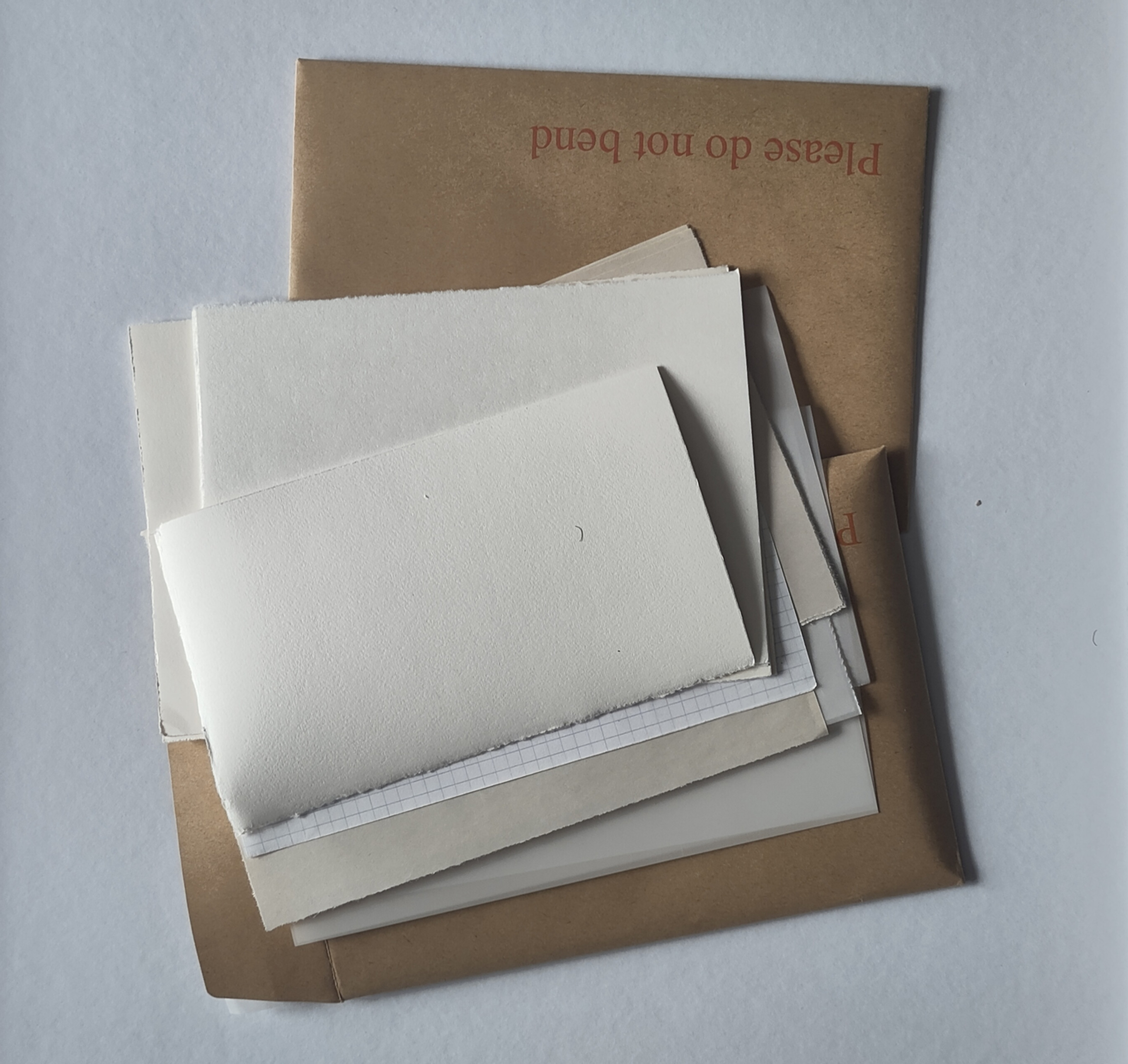
Sometimes the most fruitful experiences come when you have the least with which to work. I went backpacking and hiking through Argentina, Peru, Bolivia and Colombia for more than two months last year, and only had a minimum complement of equipment. I took very little paper, but found there was plenty all around – food packaging, leaflets, maps, handouts, airline tickets, teabag wrappers. I only had a single pot of Akua ultramarine blue, a tiny roller and an A6 piece of Perspex, but I didn’t feel restricted – I felt free to dive deeply into the few materials I had.
That being said, I’m excited to be back in my studio to see how and if the work progresses. Watch this space.

Your process is very imaginative, as well as resulting in beautiful prints. How did you learn to think outside the box in printmaking and what projects/experiences have inspired you to do that?
The origins are easy to trace – Carl Heywood, Otis Tamasauskas, Sylvat Aziz. I had the best professors when I was doing my undergraduate degree, who never said ‘no’, just ‘try’ and ‘try harder’. Colour, shape, texture, message, meaning. Flavour. Understand the medium deeply, so when you want to break rules, you can do it beautifully.
The most ambitious example of this are a triptych of screenprints on brass as part of my CUH Hispathology commission.
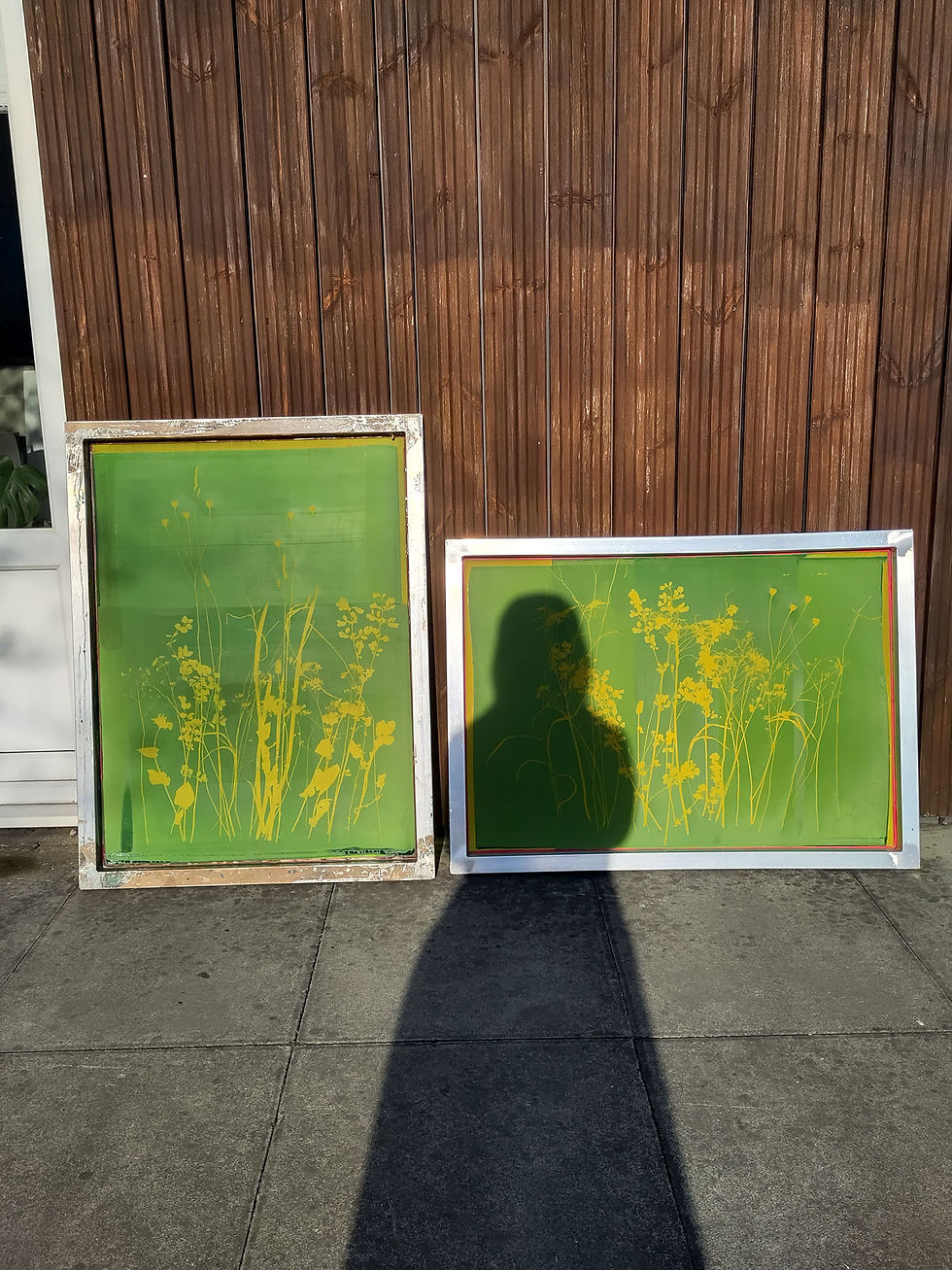
Rather than photograph or draw plants from the nearby nature reserve, I foraged for them with a park ranger and exposed them directly onto large screens.*** Rather than paper, I printed them on to brass, a metal that is both beautiful and used in lab environments for its antimicrobial properties.
Rather than conventional inks, I used thermo- and UV-reactive inks, and worked with framers to create custom frames with rear cut-outs. These are mounted away from the wall, so viewers can actually touch the back of the work and the heat from their hands will pass through the brass and activate the ink, causing colours to change.

It isn’t novelty for novelty’s sake, however. All of these process changes echo processes that happen in histopathology - using real samples, employing inks and dyes to reveal information, trying alternative processes to improve the overall outcome. I really wanted to make work that spoke to the lab’s environment and processes, and I think each of these changes contributed to that effect.
In the gallery, you’ll see a series of small brass pieces made from offcuts of this work. They work on their own, but there is a bonus to unlock if you shine a UV light on them, one of the layers will light up purple, nature revealing itself in unexpected ways.
***I used my own screens and understood the risks. Do not try on borrowed screens!
Sustainable printmaking is one of the key priorities in your studio. What new things have you been working on with that since your last blog interview here?
Ah, so this is where I’ve change the most since the last time we spoke. I continue to work without traditional solvents or mordants wherever possible, and to look for safer, more sustainable alternatives. I’m always interested when ink manufacturers and paper mills develop products that are more sustainable – Akua inks, Hahnemühle bamboo and hemp papers, Liquitex bio-based acrylics.
When I’m teaching, I design courses that either eliminate or limit exposure to harmful substances, I use studio offcuts or discards for printing, and I try to give people options to get the most out of what we’ve made.
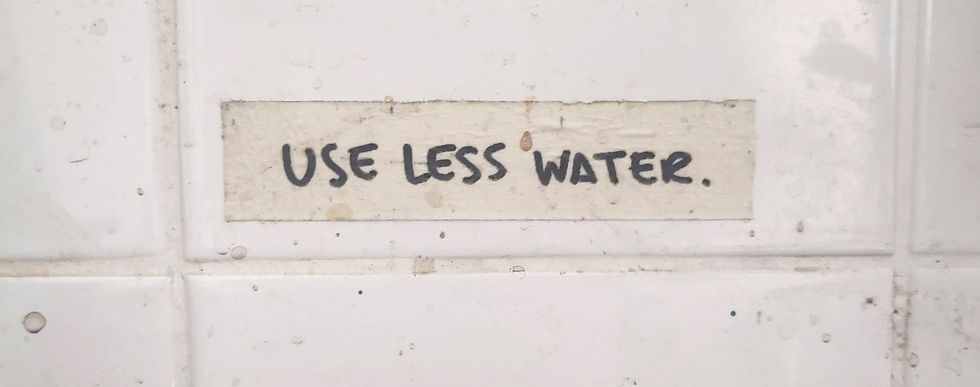
In my own practice, I am simply using less, and using less new, especially in terms of the big resources – water and power. Water use has become a bit of an obsession of mine, and it seems especially relevant now. I really stretch consumables – tissue paper in my studio undergoes a minimum of three uses before it is discarded: first to support drying prints, and then as a buffer for making prints, and finally cut down into squares for inking up. Where I’ve sold out a limited print, I’ve produced a second edition – it’s not a deception, the new prints are different, each is clearly signed as a second edition and I am getting the most out of a metal or polymer plate by doing this.
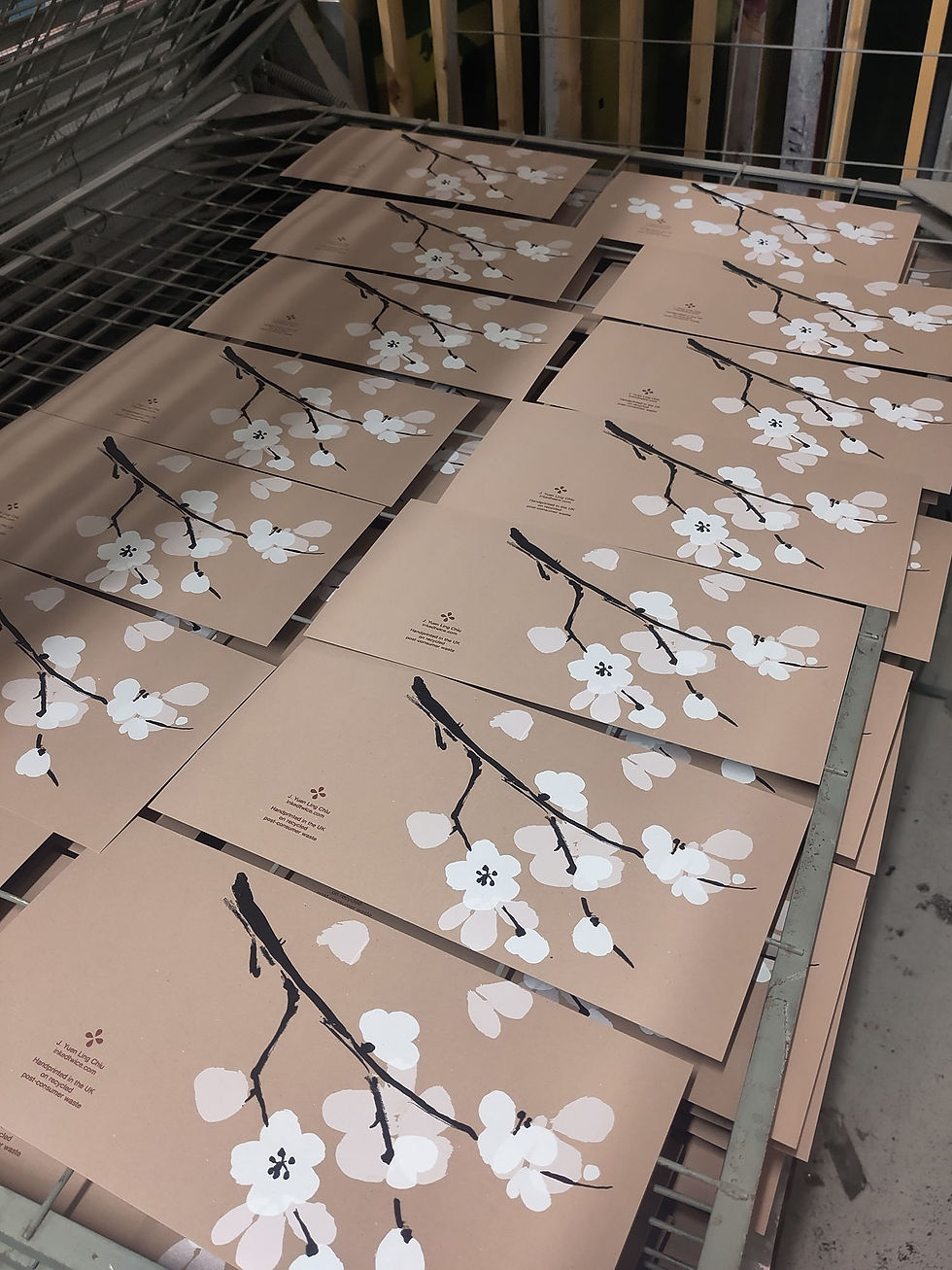
This might seem counter to my ‘chaotic brute force’ approach, but they work hand in hand – being open to different approaches and getting the most out of each one.
At the end of the day, however, I don’t think my prints ‘read’ as particularly sustainable or inclusive. They look like what they are – etchings, lithographs, screenprints – and the sustainability aspect is largely invisible, even if it is very important.
That is both a good and bad thing. I don’t think sustainability means compromising on the quality of the image making, but how do you show people something that isn’t there? I’m still working on that bit.
Ling is our featured artist in our gallery in Greenwich Market until August 23, and her beautiful prints are available there and in our online shop all year round. For more information, visit her website, her artist’s page and follow her on Instagram @inked_twice.

Comments